The Real Creative Crisis in the Age of AI
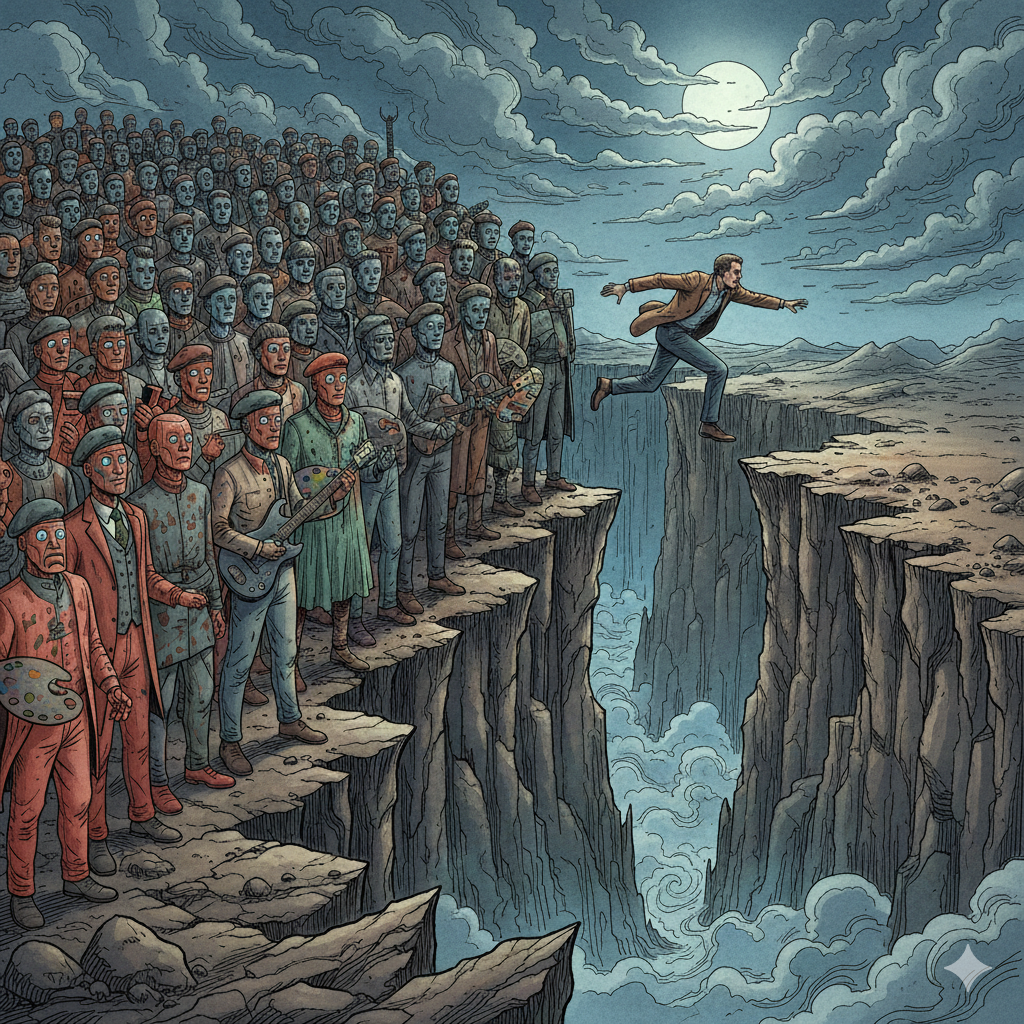
Those of us working in the creative industries are facing a new and sobering challenge. Despite what many of us once predicted, our livelihoods are now firmly on the frontline of the AI revolution.
Tools that assist with writing, composing, producing and visual creation have been among the first to gain widespread adoption. Anyone with an internet connection can now generate their own music, images, videos and written content. This undeniably affects our perceived value and, in many cases, our income as creative professionals.
Yes, this shift will devastate a lot of creatives. And yes, it will radically reshape the playing field. But I do not believe this is the most serious threat.
AI, by design, is a collector and processor of data. What it produces is essentially a synthesis of what already exists. If we ask AI to “generate a song in the style of Cat Stevens,” it draws from his catalogue and blends together the recurring sounds, structures and emotional tones of his work. The result is a familiar, safe composite that is, in theory, designed to appeal to the average Cat Stevens listener.
I say “average” deliberately. True devotees will likely find it bland and inauthentic. Casual listeners may recognise the similarities, but probably will not be moved deeply enough to become real fans. The output exists in a comfortable middle ground that rarely inspires passion.
This same logic underpins the algorithms that shape our social media feeds, Spotify playlists, and YouTube and Netflix recommendations. AI uses historical data, statistics and behavioural patterns to predict what we might want to see, hear or buy. Even major labels and entertainment companies rely heavily on this data when deciding who and what to promote. Their investments are guided by what appears safest, most profitable and lowest risk.
When success is determined primarily by past performance, the chances of truly revolutionary artists emerging from this system shrink dramatically. The next Beatles, Queen or Elvis is unlikely to be born from an algorithm optimised for averages.
In earlier eras, record labels and producers, particularly in the US and UK, often took chances. They gambled on instinct, personal taste and gut feeling. Many of those bets failed, but some reshaped music forever.
Here in Australia, our industry has traditionally been more conservative. Only a small number of artists have been fully embraced locally before gaining recognition overseas. Perhaps our market is simply too small to absorb repeated failures. But the downside of caution is stagnation.
Across art history, major shifts rarely came from playing it safe. In the visual arts, countless painters became recognised only long after their deaths, especially those who explored unfamiliar territory and challenged existing ideas. What once seemed strange or unmarketable later revealed itself as a new way of seeing.
At this point in time, AI is not capable of that kind of leap. It cannot imagine a style that has no precedent. Ask AI to “write a hit song in the style of absolutely nobody,” and it has nothing to anchor itself to. It also cannot predict how a genuinely new sound might be received, because there is no data yet to analyse.
So what happens when something truly new is uploaded to Spotify? Does it get pushed and discovered? Or does it fail to match existing patterns and quietly disappear into a vast ocean of unheard work?
This is the real challenge we face.
Our greatest task is not competing with AI-generated music. It is having the courage to create music that does not fit the mould, and then finding ways to help it be heard. If we do not, we risk allowing our art form to be steered entirely by algorithms and homogeneity, rather than imagination, risk and human curiosity.